廣東話(繁中)
 English
 簡體中文
Bordeaux is the French region Hong Kong drinkers know best, and also the easiest to get wrong: the same word on a label can mean a modest regional wine or a first growth. The fix is simple — work out the bank first, then the tier.
🍇 Grapes
[ edit ]Six red varieties are permitted: Cabernet Sauvignon, Merlot, Cabernet Franc, Petit Verdot, Malbec and Carmenère. Whites rely on Sémillon and Sauvignon Blanc, the latter also the base of Sauternes[1]. Blending is the region's core logic: varieties ripen at different times, so blending balances structure, fruit and aroma and stabilises quality year to year.
🌍 Geography
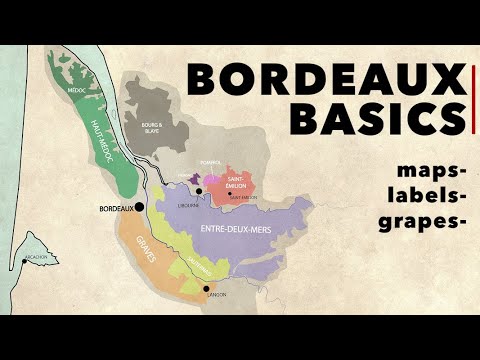
[ edit ]The Gironde estuary divides the region into Left Bank, Right Bank and Entre-Deux-Mers[3]. The Left Bank runs through the Médoc — St-Estèphe, Pauillac, St-Julien and Margaux, plus Haut-Médoc, Listrac and Moulis — then Pessac-Léognan and Graves, and the sweet wines of Sauternes and Barsac. Gravel soils drain well and store heat, suiting late-ripening Cabernet Sauvignon[3]. The Right Bank centres on Pomerol and St-Émilion, with clay and limestone that suit earlier-ripening Merlot.
👃 Aroma and palate
[ edit ]Left Bank: cassis, black cherry, cedar, pencil lead, tobacco and graphite with firm tannin; Pauillac in particular is dense and powerful[4]. Right Bank: red plum, blackberry, chocolate, truffle and earth with rounder tannins, usually drinkable three to five years earlier[3].
🍷 Vintage and classification
[ edit ]Vintage variation is large. Top Left Bank wines can age 20–40 years; regional Bordeaux is best within three to eight[2][4]. The 1855 classification covers only the Left Bank (Médoc and Sauternes); St-Émilion has its own ranking, revised roughly every decade[3]. Always check which classification a "classed growth" belongs to.
🍽️ Food pairing
[ edit ]Left Bank with roast lamb, steak and hard cheese; Right Bank with braised beef, duck breast, roast chicken and mushroom dishes. With Cantonese food, black pepper beef and roast lamb suit the Left Bank, while red-braised pork, soy chicken and cured-meat rice suit the Right Bank. Avoid steamed seafood and sour-spicy dishes.
🛒 Buying
[ edit ]Bordeaux spans the widest price range in the wine world[1]. For everyday drinking look at Bordeaux or Bordeaux Supérieur; the best value is usually Cru Bourgeois in the Médoc or the Right Bank satellites; first growths are liquid assets as much as wine, and counterfeit risk means buying through reputable merchants. Always check the vintage report before paying a premium.
❓ FAQ
[ edit ]💡 Q: How do I tell Left from Right Bank?
A: The Gironde estuary: north and east is the Right Bank (Pomerol, St-Émilion); south and west is the Left Bank (Médoc, Graves)[3].
💡 Q: Must Bordeaux be a blend?
A: Six red varieties are permitted and most wines are blends; single-variety examples exist but are rare[1].
Q: Is the 1855 classification still valid?
A: Yes, but it covers only the Left Bank and has been amended once since, when Mouton was promoted in 1973[3].
💡 Q: What should a beginner buy?
A: A St-Émilion or Haut-Médoc Cru Bourgeois with five to ten years of age.
📚 References
[ edit ]🎥 Videos
4 related videos · click to play
 Play