廣東話(繁中)
 English
 簡體中文

30-second summary
[ edit ]- Richard Lam Chun-keung (林振強; 21 January 1948 – 16 November 2003) was a Hong Kong lyricist, newspaper columnist, cartoonist and creative director in advertising, who wrote more than a thousand Cantonese song lyrics in his lifetime[1].
- He is grouped with Lam Man-chung (林敏驄) and James Wong (黃霑) as the "two Lams and one Wong"; throughout the 1980s and 1990s a great many of the love songs, up-tempo numbers, novelty songs and family-themed songs familiar to Hong Kong listeners came from his pen[1].
- He held senior creative posts at Wong & Lam Advertising, Thompson Advertising, Giordano and Next Media; the television advertisement for the launch of Apple Daily in which "Fatty Lai" is shown pierced by arrows was his work[6].
- He died of lymphoma at Queen Mary Hospital on 16 November 2003, aged 55; Leslie Cheung and Anita Mui also died the same year, which Hongkongers regard as the most sorrowful year in the history of the local music industry[1].
🧭 At a glance
[ edit ]| English name | Richard Lam Chun-keung (林振強)[3] |
|---|---|
| Born / died | 21 January 1948 – 16 November 2003 (aged 55)[1] |
| Ancestral home | Huiyang, Huizhou, Guangdong[1] |
| Education | Salesian School and Salesian English School; repeated Form 5 at Yan Pak English Secondary School; Form 6 at New Method College; matriculation at Wan Shing English Secondary School[1] |
| Study abroad | Went to the United States in 1968 and returned to Hong Kong in 1973 after obtaining an MBA[4] |
| First job | Marketing at Crocodile Garments, later a junior systems analyst in the computer department of Chase Bank[4] |
| Spouse | Yim So-kwan (嚴素君), married on Valentine's Day 1976; in 2013 she published a book recalling her husband under the name "Onion Wife"[1][4] |
| Children | One son (born 1983)[4] |
| Family | Elder sister Eunice Lam (林燕妮, writer), younger sister Lam Ngan-nei (林雁妮), younger brother Lam Chun-kong (林振剛)[1] |
| Pen-name persona | "Onion Head" (洋蔥頭) — the cartoon character he created, and also his nickname[1] |
🕰️ Chronology of his life
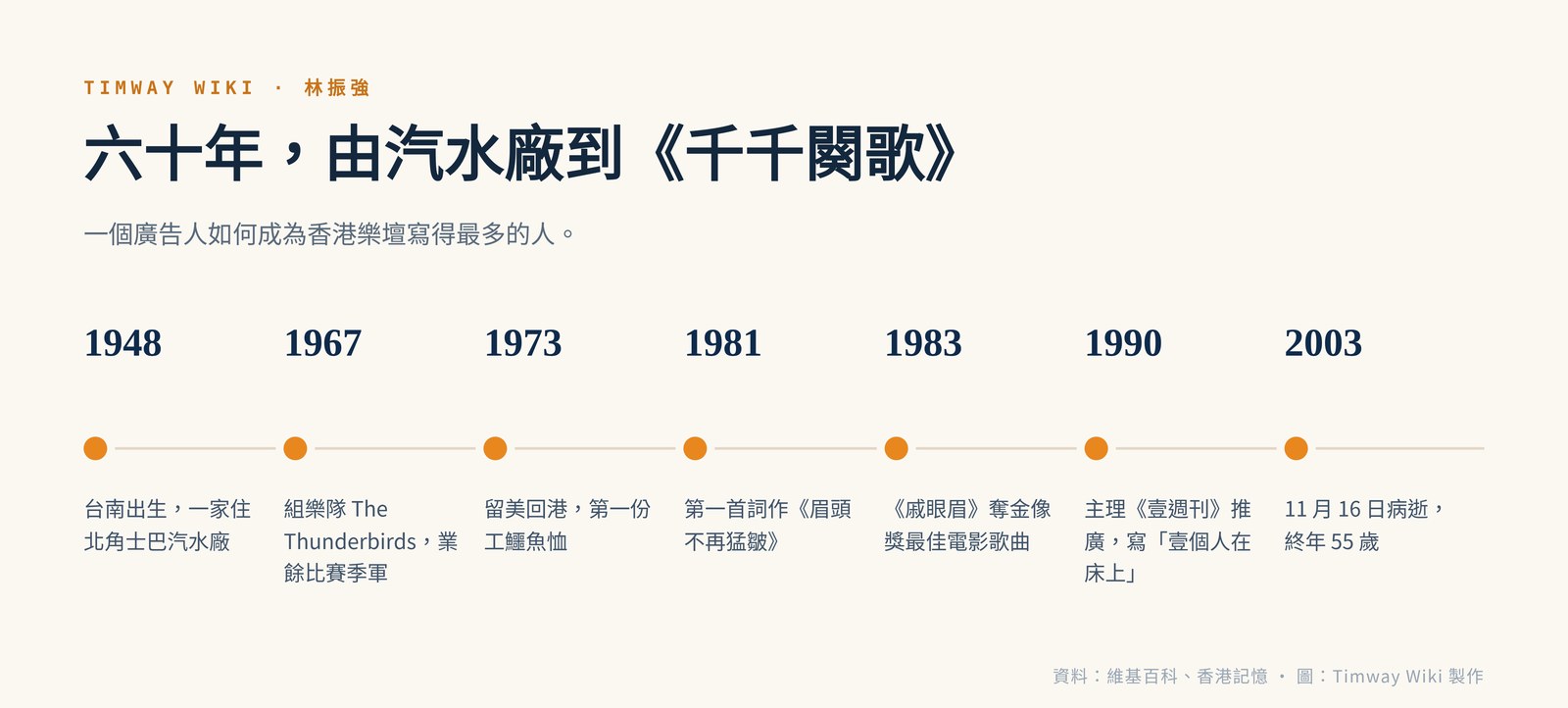
[ edit ]| Year | Event |
|---|---|
| 1948 | Born on 21 January; his father was the manager of the Spa soft-drink factory in North Point, and the family lived on the factory premises[1] |
| 1967 | Formed the band The Thunderbirds with friends and played lead guitar; took third place in the Sing Pao amateur musical talent contest[4] |
| 1968 | Left for the United States to further his studies[4] |
| 1973 | Obtained an MBA and returned to Hong Kong to work in marketing at Crocodile Garments[4] |
| 1975 | Translated dubbed programmes for Television Broadcasts Limited; moved to a junior systems analyst post in the computer department of Chase Bank[4] |
| 1976 | Married Yim So-kwan on 14 February[4] |
| 1978 | Joined Wong & Lam Advertising, founded by his sister Eunice Lam and James Wong, formally entering the advertising industry[1][4] |
| 1979 | Began writing the "Onion Head" column in Ming Pao Weekly; collaborated with Anders Nelsson on advertising jingles[4] |
| 1981 | Published his first lyric, "眉頭不再猛皺" (sung by Teresa Carpio)[1] |
| 1982 | Published his first collection of doggerel verse, 串燒洋蔥頭[4] |
| 1983 | His son was born; "戚眼眉" won Best Original Film Song at the 2nd Hong Kong Film Awards; appointed creative director of Thompson Advertising[4] |
| 1986 | Judge on Asia Television's "Future Idol" contest; received Commercial Radio's Chinese Song Chart Award for Most Contributive Lyricist[4] |
| 1987 | Wrote the English lyrics of "The Greatest Song" for Elisa Chan, performed at the Tokyo Music Festival[4] |
| 1988 | Appointed creative director of Giordano[4] |
| 1989 | Moved to Singapore, thereafter shuttling frequently between Hong Kong and Singapore[4] |
| 1990 | Led the promotional creative work for Next Magazine and wrote the column "壹個人在床上"[4] |
| 1995 | Led the promotional creative work for Apple Daily and wrote its front-page headlines[4] |
| 1998 | "天下無雙" won the Best Chinese (Pop) Lyric Award[1] |
| 2003 | Died at Queen Mary Hospital in the early hours of 16 November[1] |
| 2004 | Radio Television Hong Kong posthumously awarded him the Golden Needle Award, Television Broadcasts Limited the Honorary Award, and CASH the Music Achievement Award[1] |
👨👩👧 A child raised in a soft-drink factory
[ edit ]Richard Lam's father managed the Spa soft-drink factory in North Point, and the family lived on the premises. He was the second of four siblings: his elder sister was Eunice Lam, later known as one of the "talented women of Hong Kong", and he had a younger sister, Lam Ngan-nei, and a younger brother, Lam Chun-kong[1].
He attended Salesian School from Primary 4 to Form 5 and was a typical pupil with uneven results — strong in Chinese, average in other subjects. His public examination results were not sufficient for him to continue at the same school, so he transferred to Yan Pak English Secondary School to repeat Form 5, completed his matriculation through New Method College and Wan Shing English Secondary School, and finally entered Hong Kong Baptist College[1].
The family later suffered blows that few could imagine: in 1981 his 26-year-old sister Lam Ngan-nei died of lymphoma, and he wrote her story into "笛子姑娘"; in November 2003 he himself died of the same disease; six weeks later his younger brother Lam Chun-kong also died of lymphoma, on the very day Anita Mui died[1].
🎸 From band teenager to returning graduate
[ edit ]Many people remember him only as a lyricist, but he began in a band. In 1967 he formed The Thunderbirds with friends, played lead guitar, and took third place in the Talent Quest amateur musical talent contest organised by Sing Pao with a cover of "Papa-Oom-Mow-Mow"; the band also recorded a 45 rpm single[4].
In 1968 he went to the United States to further his studies, returning to Hong Kong in 1973 with an MBA. His first job was in marketing at the clothing brand Crocodile Garments, after which he moved to a junior systems analyst post in the computer department of Chase Bank — the same period of experience that Wikipedia describes as "computer programmer at an American-owned bank"[4].
💼 Advertising and media: from Wong & Lam to Apple Daily
[ edit ]In 1978 he joined Wong & Lam Advertising, co-founded by his sister Eunice Lam and James Wong, formally entering the profession. The company's art director at the time was the photographer Water Poon (水禾田); he stayed there for about a year and a half, and after mastering the craft he moved on and began to be given opportunities to write lyrics for advertising jingles[1].
His subsequent CV reads almost like a roll-call of the Hong Kong advertising industry in the 1980s: creative director of Thompson Advertising in 1983, creative director of Giordano in 1988, head of promotion for Next Magazine in 1990, and head of promotion and writer of front-page headlines for Apple Daily in 1995[4]. The television advertisement for the launch of Apple Daily, in which "Fatty Lai's whole back is studded with arrows", is still used as a case study in marketing courses[6].
He once said that writing advertising jingles was "no fun" because of "all the restrictions" — a jingle has to serve the brand and the running time, whereas a pop lyric can tell your own story[4].
✍️ How he wrote a lyric
[ edit ]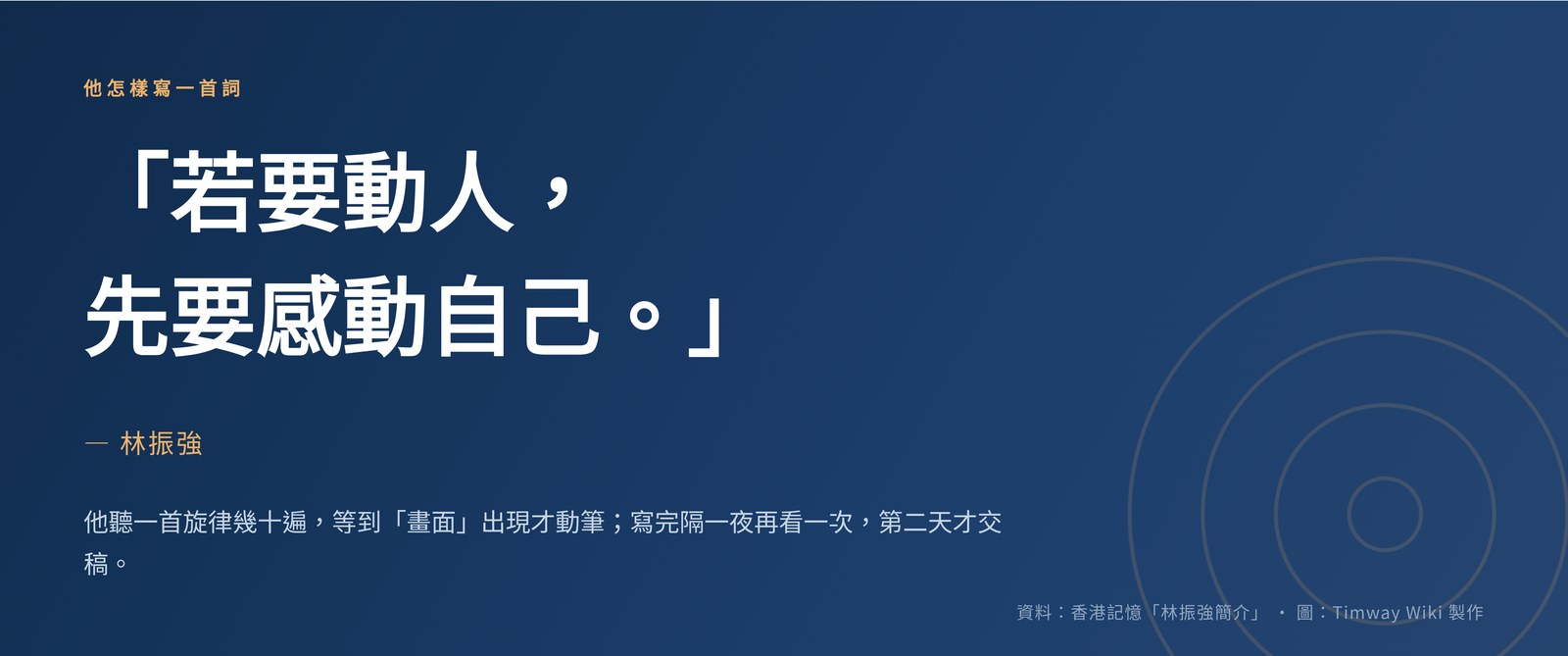
Richard Lam's method was consistent: he would listen to the melody many times over until "I feel what I ought to write for that melody", and only then put pen to paper. If nothing came after repeated listening, he would set the song aside for a day or two, or play it to his wife and ask her what she felt[4].
He stressed that "the image comes before the words": "When I write lyrics, the image always comes first and the words after; if it is just a pile of words, I don't know how to write it." When writing "空凳" (Empty Chair), he first pictured an empty chair, and the whole story grew out of that chair[4].
After finishing, he would sing the lyric through several times to make sure the sounds of the words fitted the melody and that "鐘" did not turn into "糉"; he tried to leave the draft overnight and submit it only after revising it the next day[4]. He also stated that profanity and excessively vulgar colloquialisms would not go into his lyrics, because "these are ugly things"[4].
Where did inspiration come from? His answer: "Sometimes I find it by the roadside, sometimes in the bedroom, sometimes even on a pretty girl, but most of the time I find it in my heart."[4]
🎵 Representative works: from love songs to family songs
[ edit ]The range of his subject matter was enormous; the following are among the works most often cited from his pen (years given where verifiable)[1][4]:
| Song | Singer | Why it matters |
|---|---|---|
| "眉頭不再猛皺" | Teresa Carpio | His first published lyric, in 1981 — the starting point |
| "笛子姑娘" | Johnny Yip | Wrote his 26-year-old sister's death into a song, a rare Cantonese song confronting death and remembrance directly |
| "空凳" | Danny Summer | A song of father and son, and of remembrance, beginning with "an empty chair" |
| "每一個晚上" | George Lam | One of the most frequently covered farewell songs of the 1980s |
| "追憶" | George Lam | Writes about growing up through childhood images, regarded as representative of his "image-first" approach |
| "零時十分" | Sally Yeh | His love songs can be very quiet, and also very fierce |
| "暴風女神 Lorelei" | Alan Tam | Brings mythological imagery into Cantonese up-tempo songs |
| "摘星" | Danny Chan | An anti-drug publicity song; Best Chinese (Pop) Lyric Award for 1984 |
| "戚眼眉" | Rowena Cortes | Best Original Film Song at the 2nd Hong Kong Film Awards |
| "千千闋歌" | Priscilla Chan | A 1989 work, still the standard song for farewell occasions |
| "每天愛你多一些" | Jacky Cheung | A perennial at weddings and karaoke; Cheung has publicly thanked him many times |
| "天下無雙" | Eason Chan | Best Chinese (Pop) Lyric Award for 1998 |
| "孤單先生孤單小姐" | Samantha Lam | His last published lyric |
(Some years in the table could not be verified song by song, so only confirmed ones are listed; the correspondence between songs and singers is given in the references.)
🎭 Spectrum of subjects: a minute of love and the long flow of affection
[ edit ]Commentators often describe his lyrics as "diverse in subject matter"; specifically, they fall into several strands[4]:
- Love: from the sudden attraction of "零時十分" to the steady affection of "每天愛你多一些".
- Family: "笛子姑娘" about his sister and "空凳" about remembrance are the kind listeners remember most readily.
- The world and society: "地球大合唱", "血肉來擋武士刀" and "摘星" turn concern and publicity messages into pop songs.
- Novelty and character sketches: "最緊要好玩", "Stand Up", "一隻蚊" and "心思思", as well as character portraits such as "傻女", "妖女" and "花花公子".
He described his principle for choosing subjects: "I always like to find something that gives me a strong feeling to write about, and let my heart drive the pen in my hand… because if it is to move others, it must first move me."[4]
The most concrete examples of that unbridled imagination are "童年時逢開窗,便會望見會飛大象", "抬着午夜明月向你單眼" and "追趕太陽似子彈" — the image first, the words after[4].
🏆 Awards and records
[ edit ]- 1983: Best Original Film Song at the 2nd Hong Kong Film Awards for "戚眼眉"[1]
- 1984: Best Chinese (Pop) Lyric Award at the Top Ten Chinese Gold Songs Awards for "摘星"[1]
- 1986: Commercial Radio Chinese Song Chart Award for Most Contributive Lyricist[4]
- 1990, 1991, 1992: CASH Lyricist Award at the Ultimate Song Chart Awards[4]
- 1994, 1995: CASH Golden Sail Most Performed Works Award, Individual Award for Most Works Performed (Lyricist)[4]
- 1998: Best Chinese (Pop) Lyric Award for "天下無雙"[1]
- 2003: RTHK Golden Needle Award (posthumous)[1]
- 2004: CASH Music Achievement Award (posthumous) and Television Broadcasts Limited Honorary Award[1]
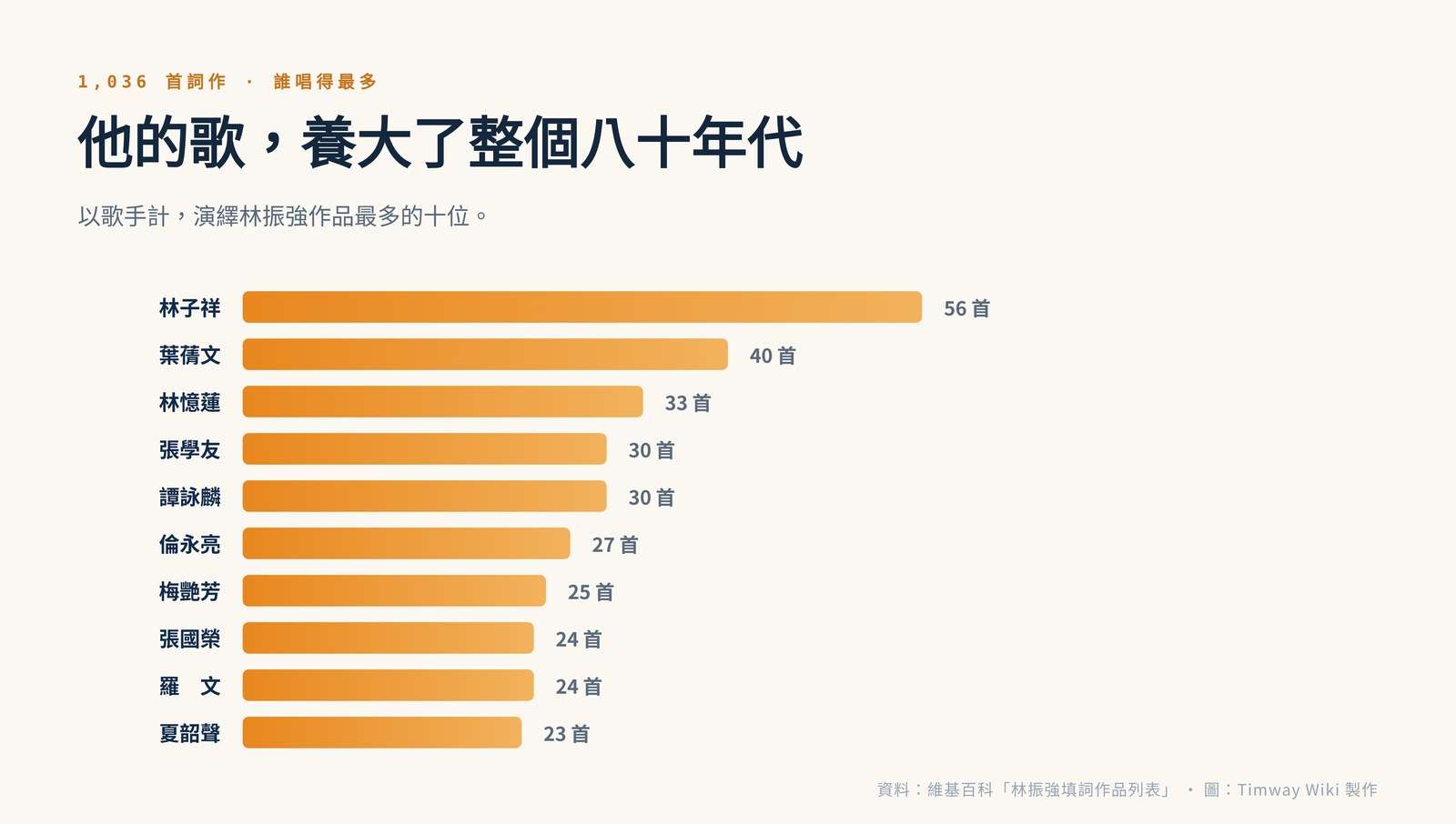
He wrote 1,036 lyrics in his lifetime. By singer, the performer of the most works was George Lam (56), followed by Sally Yeh (40), Sandy Lam (33), and Jacky Cheung and Alan Tam (30 each)[1].
📚 Onion Head, columns and books
[ edit ]In 1979 he began writing the "Onion Head" column in Ming Pao Weekly; the protagonist of the four-panel comic was lecherous and fixated on fishnet stockings, and was Hong Kong's first generation of "lewd and outrageous" urban comic characters[1][6]. The character later also became his nickname.
His output of written works was prodigious, and the titles themselves carry his tone: 串燒洋蔥頭, 洋蔥頭三及第, 霎時蔥動, 我是蔥國人, 一個人在床上, the eight-volume 鬆一鬆 series, 又喊又笑 and 今晚打女人, among others[1].
In 2013, ten years after his death, his wife Yim So-kwan published 洋蔥頭背後的林振強 under the name "Onion Wife", containing previously unpublished private photographs and an account of his creative career; the same year Next Publishing reissued a commemorative edition of the essay collection 又喊又笑[1].
🕯️ 2003: three farewells in one year
[ edit ]He gradually withdrew from the lyric-writing world in the late 1990s, and his last lyric was Samantha Lam's "孤單先生孤單小姐". In September 2003 he suddenly stopped his columns for Apple Daily and Next Magazine, and the editorial departments said only that he was on leave; his final column appeared on 13 November, entitled "汽水·燕子·姐姐"[1].
In the early hours of 16 November he died of lymphoma at Queen Mary Hospital, aged 55. His friend Calvin Poon (潘源良) said that he had been ill for two or three years and had been receiving chemotherapy and bone marrow transplants; his condition was initially good, but later fluctuated and rejection set in[1].
Because he had never made his illness public, the outside world was greatly shocked. With the deaths of Leslie Cheung on 1 April of the same year and Anita Mui on 30 December, together with his own death and that of his younger brother Lam Chun-kong, Hongkongers still call 2003 the most sorrowful year in the history of the music industry[1].
💬 What others said of him
[ edit ]- James Wong: "What is good about Richard Lam's lyrics? Their genuine feeling." He also described Richard Lam as "a small peak on an ice volcano; what lies beneath the surface is not only deep and large, but also hot as fire"[4].
- Jacky Cheung: at the 2013 "Live Remembrance: Remembering Richard Lam" concert he said: "Without Richard Lam, there would be no Jacky Cheung of today."[1]
- His wife Yim So-kwan: to Richard Lam, music "was a kind of feeling, with a mood and with images"; most of his inspiration came from amusing incidents in daily life and from life experience[4].
🇭🇰 Why Hongkongers still remember him
[ edit ]First, he could write Cantonese with great elegance and also with great vulgarity. The same pen could produce the sorrow of "笛子姑娘" and the madness of "最緊要好玩". Few later writers achieved that freedom to be "sometimes vulgar, sometimes serious"[6].
Second, his songs are still part of daily life. "每天愛你多一些" is played at weddings, "千千闋歌" is requested at karaoke, and "空凳" is listened to when remembering relatives — his lyrics are not museum exhibits but the everyday emotional tools of Hongkongers.
Third, he represents the golden age of a profession. A lyricist could at the same time be an advertising creative director, a newspaper columnist and a cartoonist; such cross-disciplinary identities have almost ceased to exist in today's finely divided market[1].
Fourth, he went through 2003 together with Hong Kong. SARS, Leslie Cheung, Anita Mui, Richard Lam — the collective memory of that year makes his death not merely an obituary but the full stop at the end of an era[7].
❓ Frequently asked questions
[ edit ]Q: How many lyrics did Richard Lam write?
A: The countable total is 1,036, generally described as "more than a thousand"[1].
💡 Q: What were his first and last lyrics?
A: The first was Teresa Carpio's "眉頭不再猛皺" in 1981; the last was Samantha Lam's "孤單先生孤單小姐"[1].
Q: What was his relationship to Eunice Lam and James Wong?
A: Eunice Lam was his elder sister; James Wong was her business partner, and the two founded Wong & Lam Advertising in 1974, with Richard Lam joining in 1978[1][4].
💡 Q: Why was he called "Onion Head"?
A: The protagonist of the four-panel comic he serialised in Ming Pao Weekly was called Onion Head, a lecherous character fond of fishnet stockings, and the name later became his nickname[1].
💡 Q: How did he die?
A: He died of lymphoma at Queen Mary Hospital on 16 November 2003, aged 55; he had stopped his columns from September 2003 but had not made his illness public[1].
📚 References
[ edit ]- Wikipedia: 林振強
- Wikipedia: 千千闋歌 (composer, lyricist, year)
- Wikipedia: Richard Lam Chun-keung
- Hong Kong Memory: Richard Lam profile and chronology
- Hong Kong Memory: Richard Lam collection
- Seeker Publishing: Onion Head Richard Lam
- Sina News: Hong Kong writer Richard Lam dies (18 November 2003)
🎥 Videos
3 related videos · click to play
 Play