廣東話(繁中)
 English
 簡體中文
The story is oddly romantic: a tsar afraid of poisoning demanded a transparent, flat-bottomed bottle so he could see what he was drinking — and that security measure became one of the most recognisable shapes in wine.
🍇 Grapes and origins
[ edit ]Founded in 1776 as Dubois Père & Fils, the house was inherited and renamed by Louis Roederer in 1833 and built its fortune on the Russian market, eventually supplying the imperial court of Nicholas II[2]. In 1876 Alexander II asked for a personal cuvée of the highest quality; Roederer selected fruit from its oldest chalk-rich vines and commissioned a Flemish glassmaker to produce a clear crystal bottle with a flat bottom[2][3].
After 1917 the wine disappeared with the Romanovs; in 1945 Roederer relaunched it commercially[3]. Cristal Rosé followed in 1976, a century after the first Cristal[4]. The house remains family-owned by the Rouzaud family, rare among the grandes marques[2][3].
The blend is Pinot Noir-led (about 55–60%) with 40–45% Chardonnay, varying by vintage; all fruit is estate-grown, malolactic fermentation is avoided (with exceptions), and about 20% ferments in wood[2][4].
🌍 Where it comes from
[ edit ]Roederer owns about 240 hectares across the Montagne de Reims, Vallée de la Marne and Côte des Blancs, supplying roughly two-thirds of its needs — unusual for a large house[2][3]. Cristal comes from seven Grand Cru villages: Verzenay, Verzy, Beaumont-sur-Vesle, Aÿ and Mareuil-sur-Aÿ for Pinot Noir; Avize, Le Mesnil and Cramant for Chardonnay[3]. The house stopped using pesticides in 2002 and converted to biodynamics; since 2012 Cristal has been made entirely from biodynamically farmed fruit[3][4].
👃 Aromas and palate
[ edit ]Typical Cristal shows citrus, white flowers, green apple, roasted nuts and chalky minerality, with laser-like acidity, a tight structure and a very fine bead[5]. Alcohol is about 12% and dosage around 8 g/L — drier and purer than most brut[4]. Young bottles are reserved and benefit from air or a wider glass; with age come honey, dried fruit and butter.
🍷 Vintages and ageing
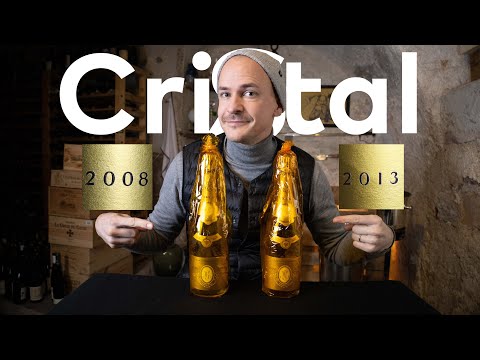
[ edit ]Cristal is made only in suitable years, aged about six years on the lees and a further eight months after disgorgement[2][3]. It can age 20–30 years, with 2008 and 2012 widely discussed as long-term propositions. Cristal Vinothèque, released after extended ageing, costs considerably more[6]. In Hong Kong, store at constant temperature away from light and vibration; the clear bottle is light-sensitive, so keep it in its box or a dark part of the cabinet.
🍽️ Food pairing
[ edit ]High acidity and purity suit seafood and white meat: oysters, lobster, steamed fish, seared scallops, poached chicken. Locally: steamed giant grouper, salt-baked chicken, shrimp toast, sashimi and sushi. Avoid heavy braised or black-pepper dishes, which make the wine seem thin. At a Chinese banquet, pour it with the opening seafood and chicken courses.
🛒 Buying and prices
[ edit ]In Hong Kong, 750 ml bottles run from about HK$1,900 to HK$2,800 depending on vintage and channel[7]; supermarkets and department stores such as Wellcome and City'Super carry recent vintages, while specialists and auction houses handle older ones. For older bottles check provenance, fill level and label condition — the clear glass makes light damage a real risk.
First-time buyers should choose a recent vintage (2015, 2016) for reliable condition; collectors may chase 2008 or 2012 at a clear premium, so compare quotes.
🏷️ Authenticity and versions
[ edit ]Cristal is among the most counterfeited Champagnes. Genuine bottles carry a laser-etched serial number, finely printed gold labels and a flat, punt-free base; some vintages add security labels. Buy from reputable merchants and keep receipts.
Beyond the standard bottling there are Cristal Rosé and Cristal Vinothèque, the latter aged longer on the lees in smaller quantities. Loose or unboxed bottles appear locally at lower prices, but provenance and storage are hard to verify — not worth the saving.
❓ FAQ
[ edit ]Q: Why is Cristal bottled in clear glass?
A: At Tsar Alexander II's request in 1876, so the wine could be seen and nothing hidden in the punt[2][3].
💡 Q: Is Cristal made every year?
A: No, only in vintages deemed good enough.
💡 Q: Does biodynamics make a difference?
A: The house credits it with fresher natural acidity and purity; since 2012 all Cristal fruit is biodynamically certified[3][4].
💡 Q: How long does an opened bottle keep?
A: A day or two in the fridge with a stopper, though the mousse fades.
📦 Scarcity, allocation and the reality of collecting
[ edit ]Cristal is produced in limited quantity, only in worthy vintages and entirely from estate fruit, so supply cannot be ramped up quickly. In Hong Kong, allocation goes mainly to fine restaurants, hotels, specialist merchants and auction houses; supermarkets receive only small quantities of recent vintages. That is one reason prices vary so much between channels.
The clear bottle cuts both ways: beautiful, but light-sensitive. The original box is not just packaging but a light shield, worth keeping for long-term storage. If you display bottles, use UV-filtered glass or dim the lighting, or the wine can develop light-strike aromas.
Vintage variation is also more obvious than in non-vintage Champagne: cool years give high acidity and tight structure needing time, warm years more generous fruit and earlier drinking. Check the vintage's weather profile before deciding whether to drink or keep.
💡 How it differs from other prestige cuvées
[ edit ]At Hong Kong tastings Cristal is often compared with Dom Pérignon and Krug. Dom Pérignon is roughly half Pinot Noir, half Chardonnay with linear acidity; Krug builds weight and roasted-nut character from vast reserves; Cristal relies on estate fruit, chalky minerality and low dosage for the driest, purest expression.
There is no absolute ranking, only occasion and taste. With seafood and steamed dishes Cristal fits best; with roast meats Krug has the weight; for weddings and gifting Dom Pérignon is the most recognisable.
📚 References
[ edit ]- Louis Roederer: Cristal
- FINE+RARE: Louis Roederer
- Rare Wine Invest: The myth of Cristal
- Winewins: Louis Roederer Cristal — the story of a legend
- Louis Roederer: Maison
- Comité Champagne
- Wellcome online: Louis Roederer Cristal Brut 750ml (HK$2,800)
🎥 Videos
4 related videos · click to play
 Play