廣東話(繁中)
 English
 簡體中文
Some products survive by changing every year. Others prove their design by refusing to change at all. Kyosho's Hanging On Racer (HOR) is the second kind: launched in 1992 as a 1/8 electric RC motorcycle, its chassis is essentially unchanged after more than three decades, and it still sells, still gets built, and still gets raced — with its most committed community in Hong Kong[1][4].
🏁 Timeline: one chassis, many bodyworks
[ edit ]The HOR's product history is less about generations than about liveries. The same 1/8 chassis, dressed in a different GP body, becomes a new kit number.
| Period | Kit | Body | Significance |
|---|---|---|---|
| 1992 | 3022 | Suzuki RGV-Γ | HOR's debut era; establishes the S.D.S.S. steering layout[4][3] |
| early 1990s | 3023 | Honda NSR500 (1991 WGP) | The defining bodywork — still why many people equate HOR with the NSR[1] |
| 2010s | 3021 | Honda NSR500 (2013) | Manual updated to 2013, showing the chassis remained in production[3] |
| c. 2016 | 34931 / 34932 | RGV-Γ / NSR500 1991 | Re-released under new numbers, identical specification[2] |
| recent | 34935T1 / 34937T1 | RGV 1992 / NSR500 1991 | "T1" versions with electronics, same chassis[3] |
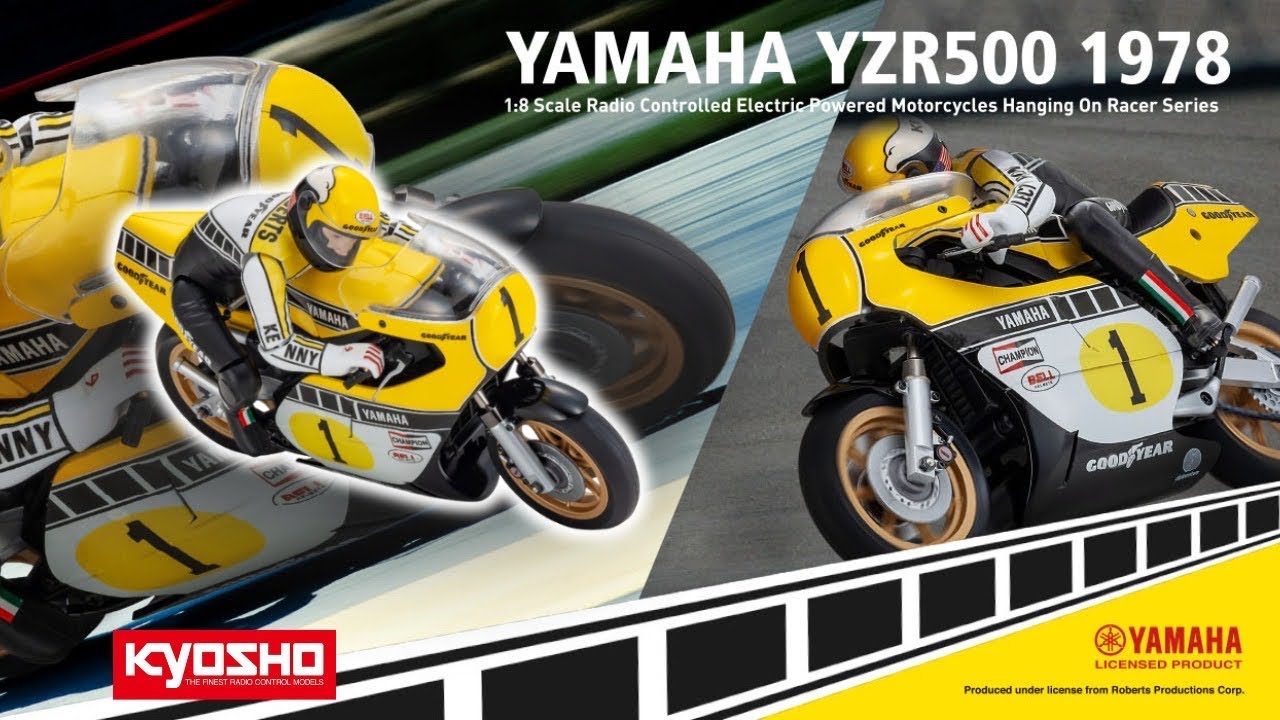
| recent | 34936T1 | Yamaha YZR500 (1978) | Yellow-black Kenny Roberts livery — proof the re-skin strategy still works[1] |
Put the 1992 kit beside the current one and the numbers match exactly: 270 mm long, 98 mm wide, 190 mm high, 185 mm wheelbase, front tyre Φ78×18 mm, rear Φ86×23 mm, 750 g, Le Mans DM20 motor[2]. In three decades the motor has not changed, the wheelbase has not changed, and the gear ratio range is still 13.80–19.30:1.

⚙️ Four design decisions that made change unnecessary
[ edit ]1. S.D.S.S. (Semi-Direct Steering System). Most RC bikes rely on gyroscopes or sheer speed to stay upright. The HOR uses a mechanical linkage that turns steering input into two things at once: steering, and a shift in the centre of gravity. Turn left, the front wheel turns left, the rider leans in, and the bike follows. That is what lets it run at walking pace without a gyro[4].
2. A rider figure with 13 connection points. The rider is not decoration; it is part of the steering system. Thirteen articulated joints let it hang off the side of the bike through a corner, exactly like a real GP rider — hence the product name[4].
3. Scale realism in the chassis. Twin-tube mainframe, inverted fork, asymmetrical swingarm with a monoshock friction damper, and a real sprocket-and-chain drive. None of this is for performance; it is for looking right. And because it looks right, people spend money upgrading it[4].
4. The Le Mans DM20 brushed motor. Small, cheap, linear and controllable — a beginner will not highside on the first lap, and an experienced owner will simply fit brushless. Kyosho deliberately left that "not fast enough" gap for the aftermarket to fill[2].
One of those unchanged decisions is the steering: the Semi-Direct Steering System (S.D.S.S.) has been carried over since 1992 with almost no structural change.
🔁 The counter-example: why not changing is an advantage
[ edit ]A normal toy follows a cycle: launch, facelift in two or three years, discontinue the old version, cut off parts, force an upgrade. The HOR runs the opposite logic: the chassis never changes, so parts remain interchangeable — a 1992 car and a 2020 car share gears, forks and even bodywork.

| Typical model toy | Kyosho HOR | |
|---|---|---|
| Facelift cycle | Major change every 2–4 years | Same chassis for 34 years |
| Old parts | Discontinued | Interchangeable, still sold |
| Product life | Tied to the version | Tied to the community |
| Source of improvement | In-house R&D | Owners (CNC, oil dampers, tyres) |
| Second-hand market | Old versions lose value | Early kits gain value |
There is a side effect. Kyosho has little incentive to invest in improvements — changing the car would upset existing owners and force a new parts supply chain. The result is product stasis and community evolution: the real iteration happens in the workshop, not the factory.
🇭🇰 Hong Kong: the most committed group anywhere
[ edit ]HOR owners exist in Japan and Europe, but for intensity of modification and density of racing, Hong Kong is unusual. The R/C Motorcycle Club of Hong Kong (RCMCHK) has operated since 2005 and runs an annual Fun Day that has passed its twentieth edition, with multiple classes and drivers across age groups[5].
Within the scene it is widely held that Hong Kong drivers are among the best in the world at HOR. That is a community view rather than an official ranking, but it is easy to test: watch an A-final at the Fun Day and see how close the racing is[5].
What matters more is that Hong Kong players do not just drive — they make. CNC aluminium parts, oil-filled dampers, high-grip tyres, brushless conversions and body protection are often developed locally and then sold back to Japan and Europe. That is why a model with no facelift still has new cars on the grid every year.
🔧 Modification culture: the real product iteration
[ edit ]Because the chassis does not change, modification becomes the only evolutionary path. The common directions today: CNC forks and swingarms, oil dampers replacing the stock friction unit, high-grip foam or rubber tyres, brushless motors with modern ESCs, slop removal in the steering linkage, and body-shell reinforcement. None of this appears in the official catalogue; all of it appears at the track[4].
For a beginner this structure is helpful: buy the stock kit, drive it until you reach its limit, then decide what to change. You never have to buy "the latest version".
📖 Want to build one?
[ edit ]This page covers history and design. For assembly, electronics and track tuning, see the step-by-step guide: How to build and optimise a Kyosho HOR.
📚 References
[ edit ]- Kyosho: Hanging On Racer series lineup (NSR500 / RGV / YZR500)
- Kyosho 34931 product page — technical data (270×98×190 mm, 185 mm wheelbase, Φ78/Φ86 tyres, 750 g, DM20)
- Kyosho support index — HOR manuals and exploded views (3021 / 34931 / 34932)
- House of RC: Kyosho Hanging On Racer (1992 debut, S.D.S.S., 13 connections, chain drive, DM20)
- Timway Wiki: The R/C Motorcycle Club of Hong Kong (RCMCHK)
🎥 Videos
3 related videos · click to play
 Play